Corner cupboard solutions: Le Mans, magic corners & corner drawers
Every way to win back a blind corner — ranked by how much storage you actually get out of it, with an honest word on cost and which layouts need one.
Book a free design consultThe corner is where kitchen storage goes to be forgotten. Two runs of cabinetry meet, one disappears behind the other, and the back of that blind corner becomes a cave you need a torch and a good shoulder to reach. The fix is the right corner fitting — and there are several, each getting a different amount of that lost space back out to you. Here they are, ranked by real-world access, with the trade-offs named.
1. Magic corner — the best reach
A magic corner (sometimes called a corner pull-out) has two tiers of wire or solid baskets. Open the door and the front set swings out, then the rear set slides forward into the gap it leaves — so the shelving that was stuck in the blind section comes right to you. Nothing stays stranded. It's the strongest option for genuine everyday access, which is why we reach for it most. It sits toward the upper end on cost because of the mechanism, and you access it from the door on one face.
2. Le Mans — full shelves that swing to the door
A Le Mans uses kidney-shaped shelves that pivot out of the cabinet one tier at a time, bringing a large, solid surface to the opening. It feels generous and sturdy — good for heavier items like appliances and stacks of crockery — and the whole shelf arrives at the door rather than you reaching in. It's a premium fitting, and it wants a decent cabinet width to work well, so it's best in larger L and U layouts.
3. Corner drawers — the seamless look
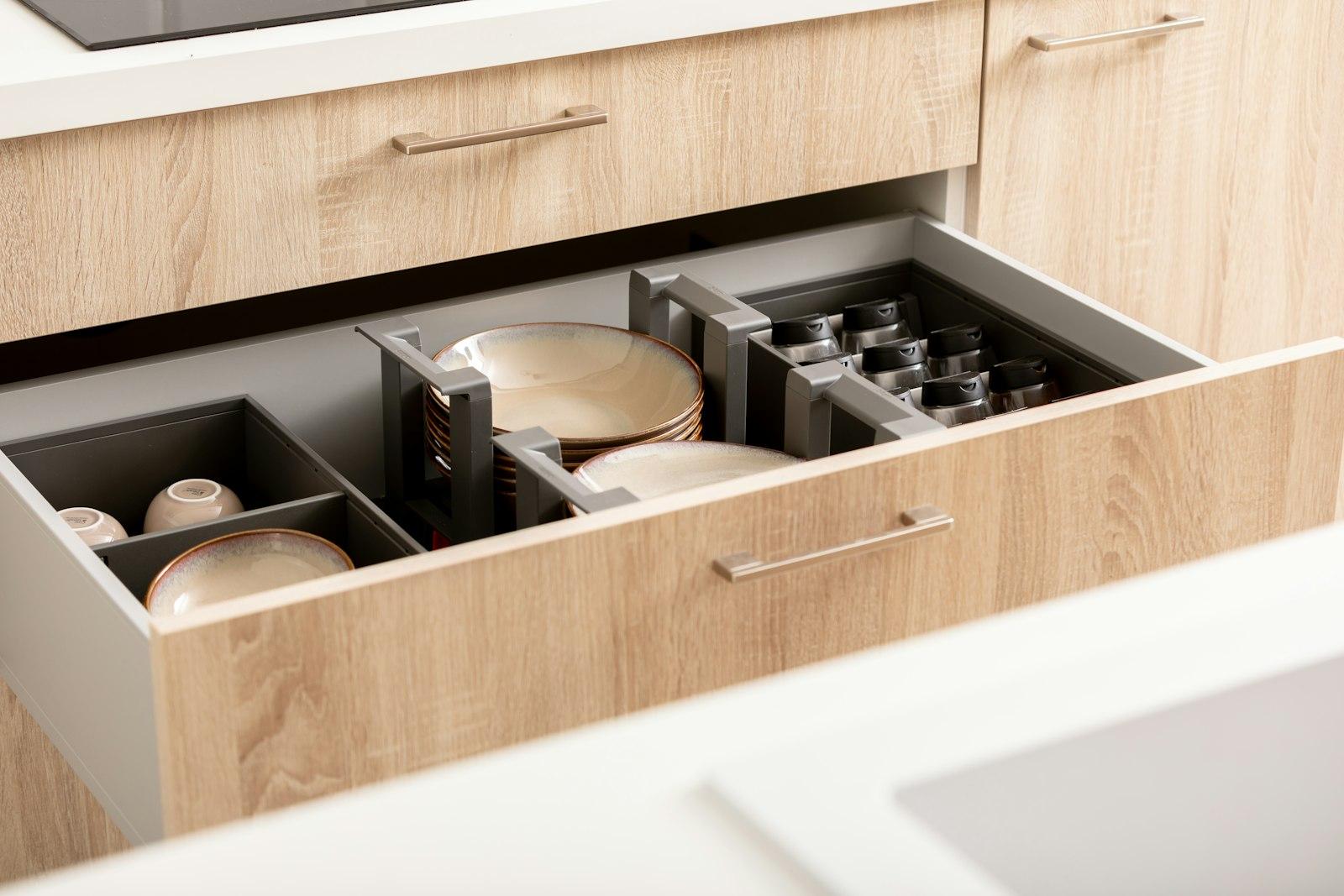
Corner drawers read as ordinary drawers from the front, set at an angle across the corner, but they open onto a surprisingly deep, useful space with full-extension runners. If you want the corner to vanish into a clean drawer bank rather than announce itself as a special cupboard, this is the one. The angled boxes and hardware make it cost more than a carousel, but the finish and the easy reach win a lot of people over.
4. Carousel (lazy Susan) — most volume for the money
The classic rotating carousel spins shelves around a central post so you turn the storage to the door rather than reaching for it. It holds the most raw volume and it's the most affordable way to make a corner usable. The trade-offs: the round shelves leave slivers of unused space in the square corners, and the central post rules out very tall or awkward items. For a lot of kitchens it's still the sensible, honest choice.
Which layouts actually need one
Corner fittings only matter if you have a blind corner, and that comes down to layout. L-shaped and U-shaped kitchens almost always have at least one, so this is money well spent. Galley and single-wall kitchens generally don't have a blind corner at all — in which case skip the hardware and put the budget into drawers, a pull-out pantry or better internal storage elsewhere.
Our honest recommendation
If access is what matters, a magic corner or Le Mans earns its price. If you want the corner to look like nothing special, go corner drawers. If the budget is tight and you just need the space usable, a carousel still does the job. Every fitting we quote is a fixed written price, installed with Blum and Häfele hardware and soft-close as standard, and built in our own Rotorua factory — so you can weigh the step-ups with the real numbers in front of you.
Frequently asked questions
What is a blind corner cabinet?
Which corner cupboard solution gives the most usable storage?
Are corner drawers worth it?
Do I even need a corner cupboard fitting?
What's the most affordable corner solution?
Get the corner working for you
Book a free design consult and we'll show you the corner fittings that suit your layout, with fixed written prices and soft-close as standard — made in our own Rotorua factory.